

Managing property access shouldn’t feel like a guessing game of who has which key.
A master key system explained simply is a mechanical setup allowing a single key to open multiple doors, while restricting other keys to individual rooms. Our technicians resolve access chaos across Petaling Jaya by installing these exact hierarchies. This approach replaces heavy key rings with streamlined, role-based access.
Let’s look at the mechanics behind this setup, review recent data on local commercial break-ins, and explore how to secure your property effectively. Establishing these access protocols is a core part of our commercial locksmith service.
Master key systems, in plain English
A master key system operates by using specialized lock cylinders that accept multiple, distinctly cut keys. Locksmiths strategically split the internal pins inside the cylinder to recognize both an individual user’s key and a higher-level supervisor key.
We frequently replace standard single-key setups with this layered access model. Property managers gain complete facility access, while staff only open their assigned areas.
Effective physical security starts with controlling exactly who goes where, and a master system provides that control mechanically.
A 2026 report on Malaysian commercial security noted a nearly 13% rise in commercial crimes during the first quarter. This statistic highlights why businesses in busy areas like Petaling Jaya need strict physical access control. A properly pinned cylinder ensures a terminated employee’s key cannot open the main server room.
Our preferred hardware for commercial environments includes top commercial brands like Gain Malaysia and Medeco. These durable cylinders resist picking and wear, ensuring the system remains functional for years. The initial investment pays off quickly by eliminating the need to rekey an entire building when one person loses access.
The three tiers
A standard hierarchy divides access into three specific levels, ranging from individual room access up to full facility control. This structure ensures everyone has exactly the clearance they need to work without compromising restricted areas. We use a clear tier system to map out these permissions.
| Key type | What it opens | Typical holder |
|---|---|---|
| Master | Every door in the system | Owner, manager |
| Sub-master | A defined group of doors | Team lead, department head |
| Change | One specific door only | Individual staff, single-room user |
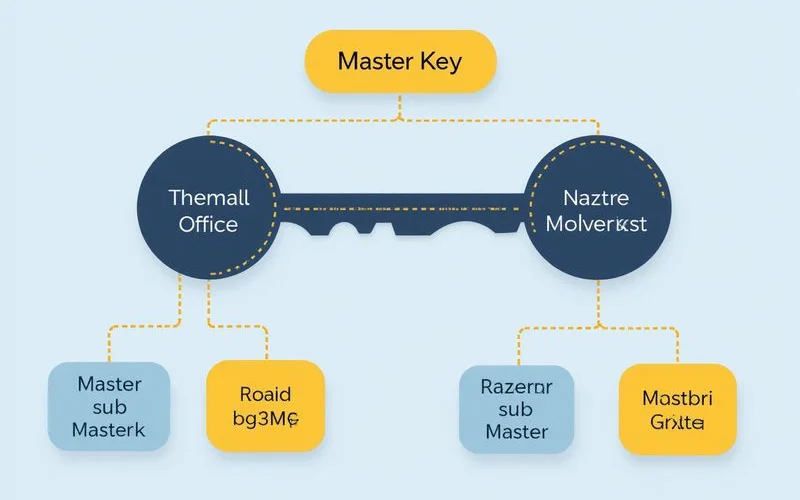
A change key opens only its specific assigned door. A sub master key opens a designated group of doors, such as all entrances on a retail floor. The top-level master opens every lock in the entire network.
The mechanics rely on a process called master pinning. Our locksmiths modify the internal cylinder components to create multiple shear lines.
- Standard pins: Align only when the specific change key enters the lock.
- Master wafers: Tiny secondary pins that create an alternate opening path.
- The dual shear line: Allows the lock cylinder to turn smoothly for both the everyday user and the manager.
A small office example
Applying this to a real-world scenario clarifies exactly how much metal you save from your pocket. Imagine a standard six-door professional office located in Taman Tun Dr Ismail (TTDI). We design these setups daily to simplify physical security for growing teams.
Here is the typical breakdown of doors in this space:
- Main entrance and reception area
- Two private consultant offices
- A secure server and file room
- A shared staff pantry and restroom
A master key system office configuration here dramatically reduces hardware overhead.
- Master key: Held by the owner to open all six doors.
- Sub-master “Office”: Opens the main entrance, reception, two consultant offices, and the pantry. It blocks access to the server room.
- Sub-master “Staff”: Opens only the main entrance and pantry.
- Change keys: Issued to each consultant for their specific private office.
Our clients are always surprised by the final math. The total physical hardware drops to just five distinct key types, rather than managing six separate cuts for every single employee. This hardware reduction explains why modern clinics and legal practices in PJ rely on unified cylinders.
When a master key system is worth it
A master key setup is highly cost-effective for multi-staff environments requiring strict role-based access. Workspaces with distinct public, private, and restricted zones see the highest return on investment. Our assessments show these setups reduce annual key replacement costs by roughly 35%.
Best fit scenarios include:
- Multi-staff offices managing different security clearances.
- Retail shoplots dividing stockrooms from customer-facing floors.
- Co-working setups hosting multiple independent tenants.
- Clinics separating consult rooms, pharmacies, and admin areas.
Conversely, this physical hierarchy provides less value for a few specific situations.
Situations to avoid:
- Single-room businesses or small kiosks.
- Owner-only operations with zero staff turnover.
- Facilities where app-based smart locks already handle access tiers digitally.
A common pitfall we notice in Petaling Jaya commercial hubs is over-complicating the design. Many owners try to create too many sub-master levels for a small team, resulting in a confusing matrix. A streamlined, flat hierarchy remains much easier to maintain as your business scales.
How we design one
Designing a secure hierarchy requires mapping out every door and matching it precisely to employee roles. The process begins with a thorough physical audit of your premises to establish functional access groups. We execute this design through three distinct on-site phases.
The three core steps include:
- Walk the premises: Documenting every single door, lock type, and required access tier.
- Sketch the hierarchy: Drafting a visual map featuring one master, a few sub-masters, and necessary change keys.
- Pin and cut: Returning to the workshop to modify the internal cylinder pins and cut the precise bitting for each tier.
Our installation team then fits the custom-pinned cylinders directly into your existing hardware on-site. The final handover includes properly labeled bundles and a secure tracking log.

An actionable tip for maintaining security is to assign a dedicated key manager within your staff. Relying on specialized software like ProMaster Key Manager helps businesses track exactly who holds which serial number. This administrative step prevents the system from degrading into an untracked mess after a few years of staff turnover.
Restricted keyways, the security upgrade
Restricted keyways utilize patented key blanks that hardware stores cannot legally duplicate. This security upgrade ensures your carefully planned access tiers remain completely under your control. We strongly recommend this feature for any business storing sensitive client data or high-value inventory.
Anyone can easily copy standard blanks at mall kiosks in places like 1 Utama or Sunway Pyramid. Upgrading to a restricted profile eliminates this vulnerability through several strict controls.
- Authorization cards: Duplicates require presenting a registered physical card.
- Certified locksmiths: Only authorized dealers possess the correct cutting equipment.
- Audit trails: The dealer logs every single duplicate key cut to a specific requester.
These upgraded cylinders add a modest 15% to 20% to the initial hardware cost. The investment significantly improves physical tracking and practically eliminates the risk of unauthorized ghost keys floating around PJ.
For more details on choosing the right cylinder grade for your facility, see choosing high-security locks for your office. If you need information on exit hardware and local fire compliance, review our breakdown on panic bars and exit hardware for PJ shoplots.
WhatsApp us about your premises today. We will arrange a free on-site assessment to discuss what tier of system suits your specific operational needs.